
Seafloor relief and ecosystems in the South Aegean
In recent decades, work has sought to identify and assess the geomorphological and environmental changes undergone by the Mediterranean. Acoustic (geophysical) remote sensing has mapped part of the seafloor relief, bedforms and subsurface geology, but coverage remains small. Extensive areas, especially shallower than 300–400 m, are still unexplored and many scientific questions remain open.
The study of palaeoclimatic and geomorphological change in the South Aegean and connected marine physiographic units is a scientific priority, because these changes largely shaped the palaeoenvironmental conditions of the Eastern Mediterranean. Sea-level response to palaeoclimate caused emergence or submergence of the shelf and thereby provided land bridges for prehistoric people and other organisms.
Another essential issue for the sustainable management of marine ecosystems is knowledge of the type, quality, quantity and spatial distribution of present-day marine habitats.
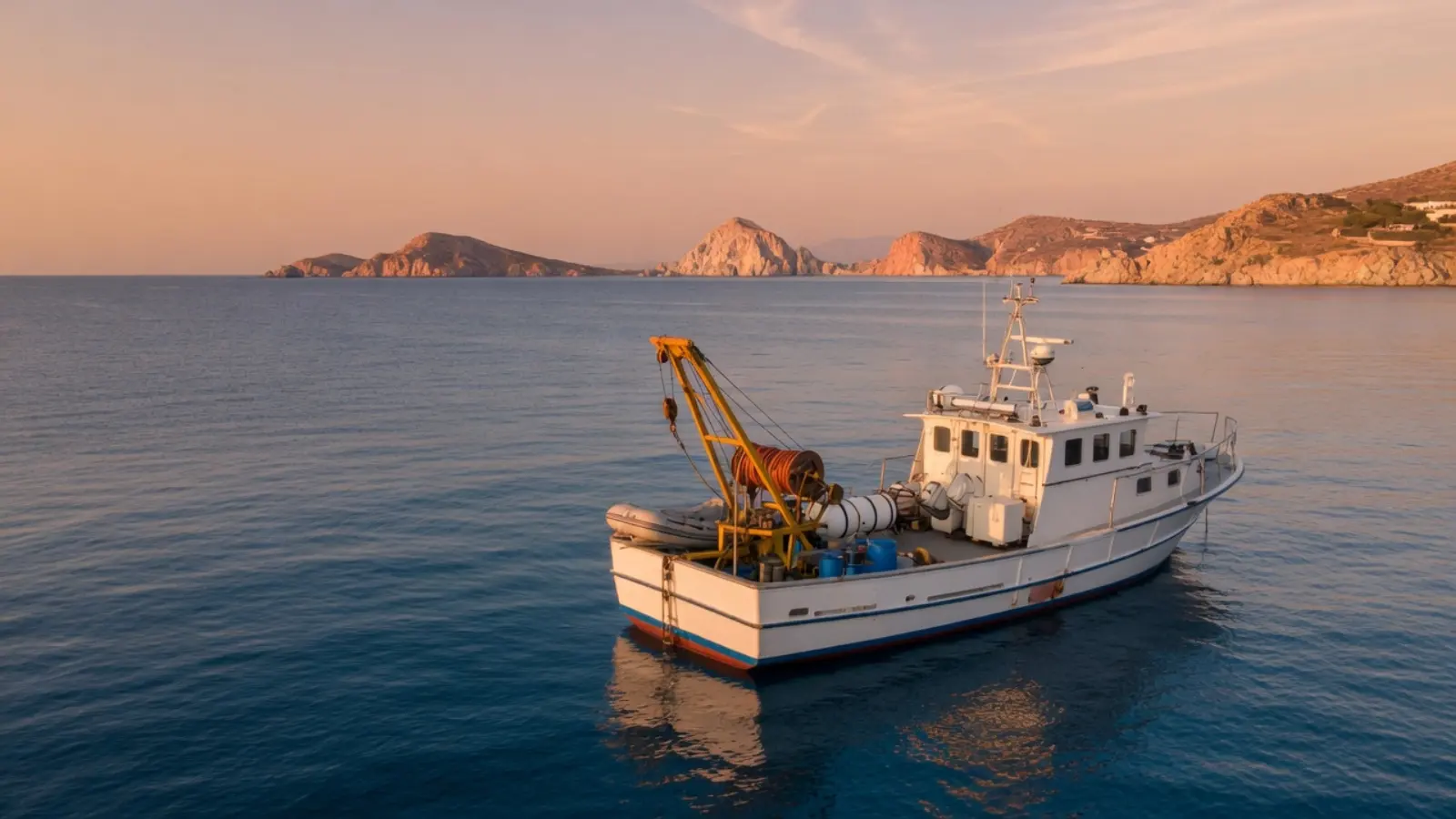
These questions fall within the South Aegean Region’s priorities for Environment and Sustainable Development. The necessary primary data will be collected during the research cruises of R/V Alkyon.
WP 3 also secures the operation of the Station’s laboratories and of R/V Alkyon’s operational capacity through regular inspection/maintenance and the upgrade/completion of laboratory, scientific, technical, nautical and electromechanical equipment.
It further provides full training of new scientific staff of HSR / HCMR in the use and maintenance of Alkyon’s existing scientific equipment (multibeam echosounder / MBES, sub-bottom profiler / SBP, CTD, ADCP and others) and of equipment purchased under the project (ROV, gravity corer and others). The ROV is used across research (sampling, filming), education and HCMR rescue operations (wreck documentation, recovery).
ROV training is in-house with HCMR’s ROV team or at a specialised centre abroad (ROV Pilot/Technician Grade II, in line with IMCA C 005).
Equipment and maintenance
Beyond research, recruitment and training, WP 3 includes:
– completing Alkyon’s scientific equipment with a gravity corer;
– completing navigation equipment of Alkyon and of launch Kirki with instruments such as AIS;
– computers, peripherals and accessories for HSR and Alkyon;
– regular inspection/maintenance of electromechanical equipment of Alkyon and Kirki (inboard engines, winches, Alkyon’s A-frame and Kirki’s outboard) in the first and second project years;
– regular inspection/maintenance of the SBE19 Seacat Profiler and SBE33 deck unit of the CTD system;
– regular inspection/maintenance, for two years (1+1), of the IMU subsystem of the multibeam echosounder;
– nautical equipment (ropes, floats and others) and electromechanical spare parts;
– maintenance tools and electronic, electrotechnical and electrical devices and materials.
Past sea-level change and geoarchaeological potential
Past climate change raised and lowered sea level: in cold (glacial) periods it stood 110–130 m below today’s position and in warm (interglacial) periods 5–10 m above it. During glacial phases most shelves were land; during interglacials the sea flooded them.
Alkyon’s equipment allows detailed bathymetric and geomorphological mapping of the South Aegean coastal and submarine space and the identification of sedimentary and erosional traces of long-term sea-level movement. Case studies will be carried out in island groups (e.g. Kos–Kalymnos–Pserimos, Naxos–Paros–Mykonos–Delos–Rineia). Palaeogeographic connections will be reconstructed in successive time steps and geoarchaeological potential assessed, highlighting underwater cultural heritage.
Present habitats and geological substrate
Habitat maps have become essential for environmental monitoring, spatial planning and the assessment of marine resources. Less than 5–10% of the sea area has been mapped at a resolution comparable to terrestrial habitats.
Mapping of substrate types around Rhodes under INTERREG GR-CY 2007–2013 “AKTI” produced derived seafloor parameters and contributed to habitat mapping. Existing information will serve as a reference and will be compared with new data from the same area and method, to identify change over the last 7–8 years. WP 3 information will be combined with WPs 5–7 to produce marine-habitat distribution maps.